
What are 10 billion humans supposed to do?
Everyone is betting on AI. Who’s investing in humans? As automation creates a civilizational surplus of people with no economic role, the real white space isn’t another model — it’s the Human OS.
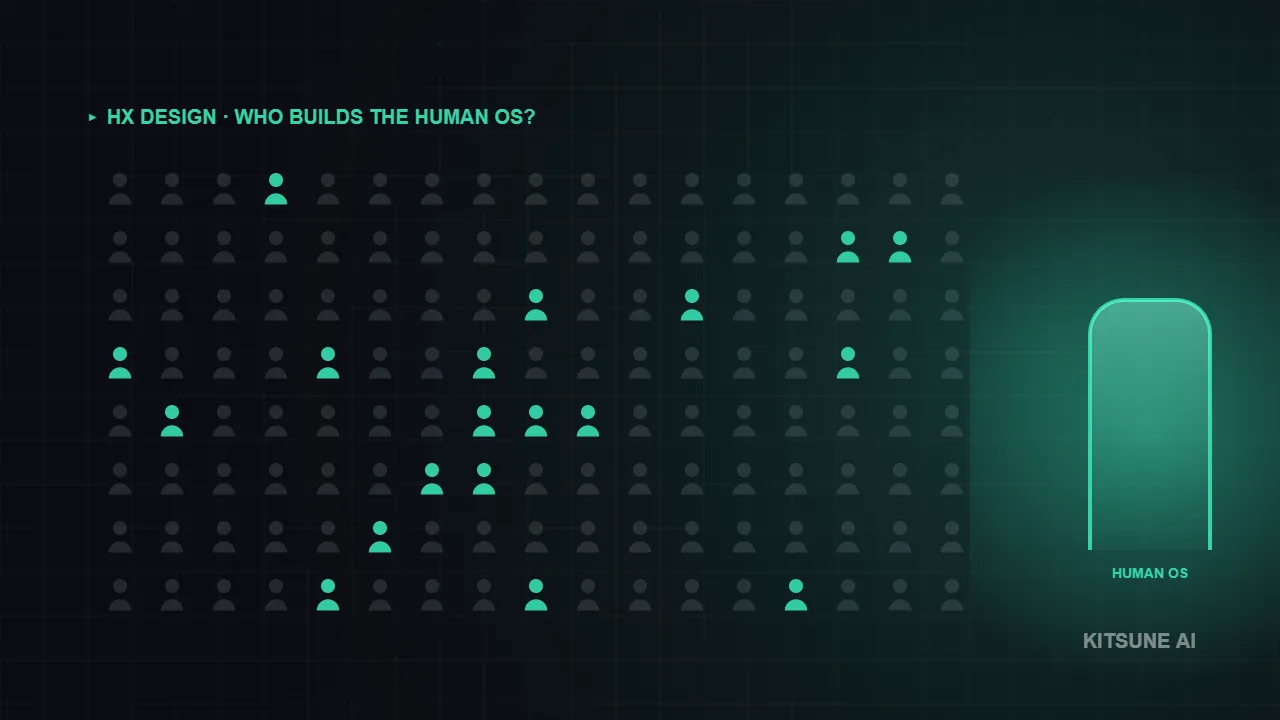
We’re building a civilizational surplus — billions of people with no economic role — and telling ourselves a comforting story about creativity and play that the human condition will not honour. The AI utopia won’t hold when people feel useless. Everyone is racing to ask what AI can do next. Almost no one is asking the trillion-dollar question: who builds the Human OS? I call that discipline HX Design.
The global population is still climbing — on its way to 10.3 billion. At the same time, credible estimates put up to 60% of today’s work within reach of automation, and McKinsey alone projects that up to 30% of the workforce in developed economies could be displaced by AI and automation by 2030. Put those two curves together and you get the uncomfortable shape of the next decade: more people, and less for them to do.
So I’ll ask the blunt version of the question everyone is tiptoeing around: what are ten billion humans actually supposed to do?
Existential redundancy
This isn’t only about jobs. It’s about income, and it’s about purpose. Follow the chain: no work means no paycheck, no paycheck means no role in the economy, and no role in the economy means, for a great many people, no felt relevance at all. We are very good at debating the first link in that chain and almost silent on the last.
No work = no paycheck = no role in the economy = no relevance.
I’ve watched what the loss of a role does to a person up close — the drift, the purposelessness, the quiet erosion of identity that comes when a craft or a career that defined someone for decades simply ends. We usually call that retirement. What automation threatens is to hand that same experience to people who never asked to leave.
The AI utopia lie
The optimistic story goes like this: machines handle the drudgery, and liberated humans spend their days on creativity, play and curiosity. It’s a lovely picture. It’s also a misread of who we are.
The human condition is not leisure. It is struggle, and the search for meaning through that struggle. Take away the struggle for the vast majority and you don’t automatically get a renaissance — you get a vacuum. And vacuums get filled. Simply telling 95% of people to “pursue their creativity” is not going to cut it.
So I don’t think the default path is utopia. I think, left undesigned, it’s chaos — and it has a texture:
- Post-work drift — the retirement-gate feeling, arriving for people who never wanted it.
- Mass purposelessness at a scale we have no social muscle for.
- Identity crisis, because so much of who we are is bound up in what we do.
- Techno-ethnic conflicts as displaced populations look for someone to blame.
- Faster conflict escalation, because the same tools that automate work also automate mobilization.
The data is already here
None of this is speculative hand-waving. The leading indicators are already pointing the wrong way, and AI is compounding every one of them:
- Global productivity is up.
- Job elasticity — the jobs created per unit of growth — is down.
- Labor-force participation is down.
- Mental-health distress is up.
- Political polarization is up.
We’re producing more with fewer people, employing a smaller share of them, and the human fallout is showing up in the mental-health and political data long before the economists agree on a cause.
Everyone is betting on AI. Who’s investing in humans?
Who builds the Human OS?
Here is where I want to flip the question. The entire industry is asking, “what can AI do next?” It’s the wrong question to organize a civilization around. The one that matters is: who builds the Human OS? — the system that designs new roles, new income models, new sources of identity and economic inclusion for humans in an AI-maximized world.
That’s the discipline I’ve started calling HX Design — Human Experience Design. Not UX for a screen; experience design for a life that no longer comes with a job attached. It is, to my mind, a trillion-dollar white space sitting in plain sight while every dollar of attention pours into the model layer.
None of this means work simply vanishes overnight. A thoughtful counter I keep hearing is that companies still need paying customers — you can substitute labour with automation, but without people earning, there’s no one left to buy, so the system self-corrects. There’s truth in that. A new, more versatile gig economy will replace the workplace as we know it; specialized roles will go AI-first, while the work that demands genuine human interface, judgment and trust will stay human for some time yet, with governance evolving in parallel.
But “people will find something to do” is not the reassurance it sounds like. The optimistic version is everyone running a tiny company with a handful of agents — real abundance. The shadow version is that abundance and redundancy are the same fact seen from two angles. If agents can do nearly everything, the binding constraint stops being productivity and becomes meaning. And meaning does not arrive automatically with free time.
Human abundance can also be construed as human redundancy. If agents are doing everything, what are the humans doing?
That’s the question I think serious builders should be sitting with. Not because AI is bad — I’m building an agentic AI company; I’m all in on the technology. But precisely because I am, I refuse to pretend the human side will sort itself out. It won’t. It has to be designed.
So don’t just ask what AI can do next. Ask who builds the Human OS. That’s the work I think is worth a generation’s attention — and it’s wide open.
Why we passed on twenty years of tech fads
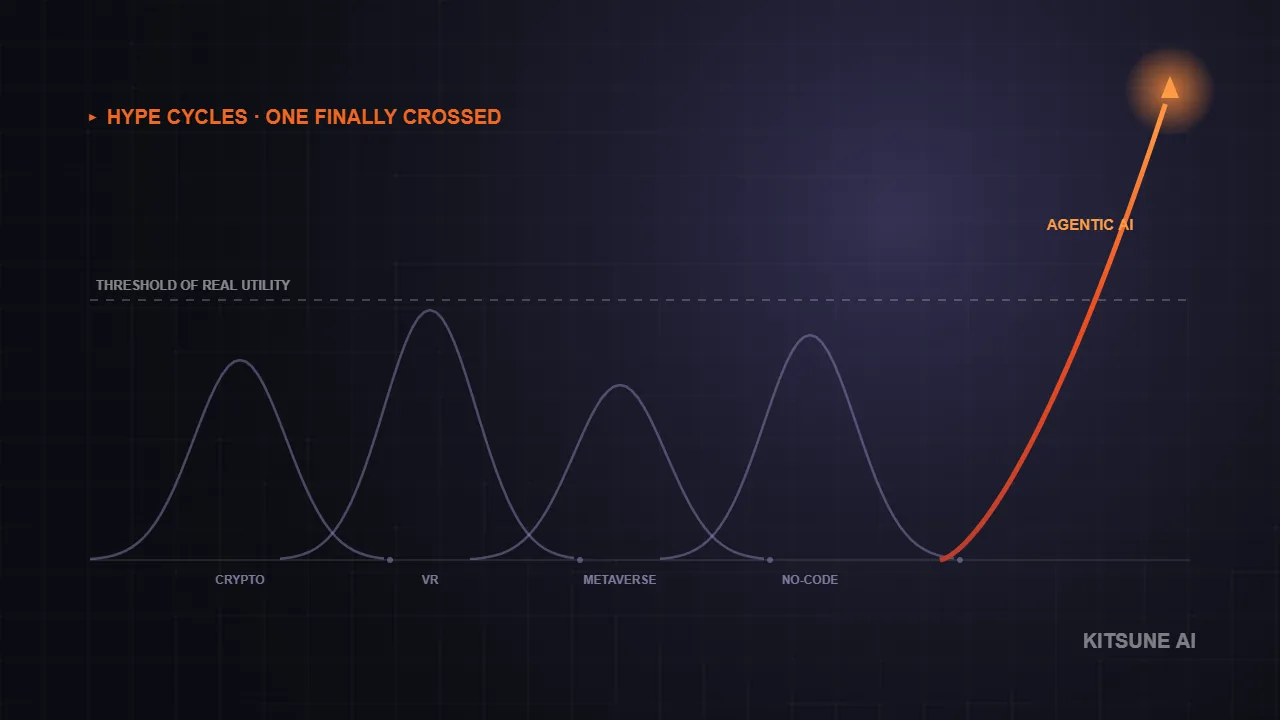
For 20 years the smart money kept pointing at the future. We didn’t move — until agentic AI passed the test.
Read article
Creator Economy 2030 — Whitepaper
Influencer marketing is dead. The seven structural shifts reshaping media, commerce and culture by 2030.
Read article